
Originally published on November, 2019 on Project 40 Collective’s Blog.
Interview was conducted by Jing Tey.

Tell us about your creative practice! How does your work as a community arts organizer inform your practice as a creator?
Currently, I identify myself as an emerging cultural producer and an interdisciplinary artist. My primary mode of creative expression involves weaving together bilingual prose and illustrations. However, I primarily function as an organizer and administrator for not-for-profit arts organizations.
My role and identity as an arts organizer remain distinct from my identity as a creator, if we equate a creator with the term “artist.” In my capacity as an organizer, I am attuned to the external — engaging with discussions, thoughts, and ideas circulating within my community and the broader society. On the other hand, my role as a creator involves a deeper attunement to the internal — the emotions and words I am compelled to explore. These often serve as responses or reflections tied to external occurrences.
When I read your jigeum.zine as well as your recent piece “Words I’ve Written to Myself” in LooseLeaf Volume 8, I sense the different layers of self that you present through a combination of fragmented bilingual thoughts, song lyrics, and illustrations. How does music and your grasp of different languages influence your process of creation?
Language constitutes a vital aspect of my identity—it shapes my interactions with the world and my own physicality. I often find myself thinking bilingually, resulting in fragmented expressions due to distinct grammatical structures and untranslatable nuances. This sense of bewilderment, stemming from my simultaneous thoughts in Korean while speaking in English, and vice versa, has significantly intensified over the past few years, particularly as I’ve taken a more active role in reading and writing in Korean (and becoming more attuned to hanja). I genuinely believe that I can’t proficiently speak just one language, but rather that two languages harmonize within me perfectly.
English is the more fluent of the two for me, especially in verbal communication, and it equips me with words for critical analysis, given that my entire educational journey has been conducted in this language (kindergarten aside). On the other hand, Korean feels more intimate and trustworthy, offering words with nuanced shades, which in turn reflects my genuine emotions. Korean allows for the play of poetics and metaphors, yet it also enables immediate human connections. In my view, Korean possesses greater diversity and malleability compared to English. Moreover, language carries distinct sociocultural contexts from its origin, influencing when I’d feel more at ease using Korean or English. Collectively, this highlights the continuous presence of multiple aesthetics and ideas in my mind, which is why I believe my work necessitates bilingualism.
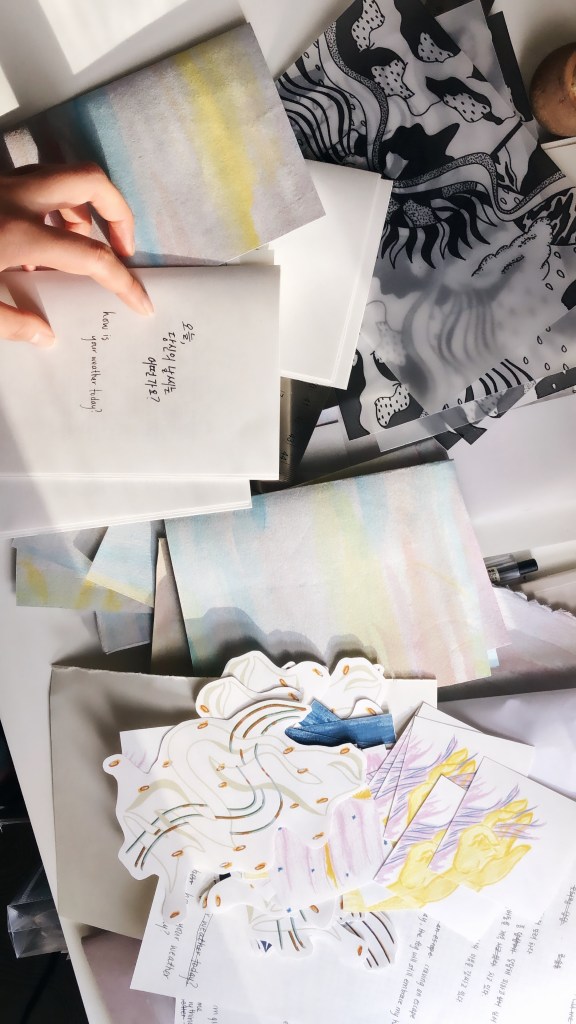
Music has consistently occupied my moments of solitude, which I’ve had quite a share of since my youth. Consequently, I’ve developed a natural fascination with song lyrics. My musical preferences span a broad range of Korean genres, encompassing everything from mainstream to indie to underground, and from hip hop to ballads to folk. These musical choices offer me enhanced avenues for self-expression. The influence of music is a constant presence in all of my creative endeavors, serving as a persistent backdrop.
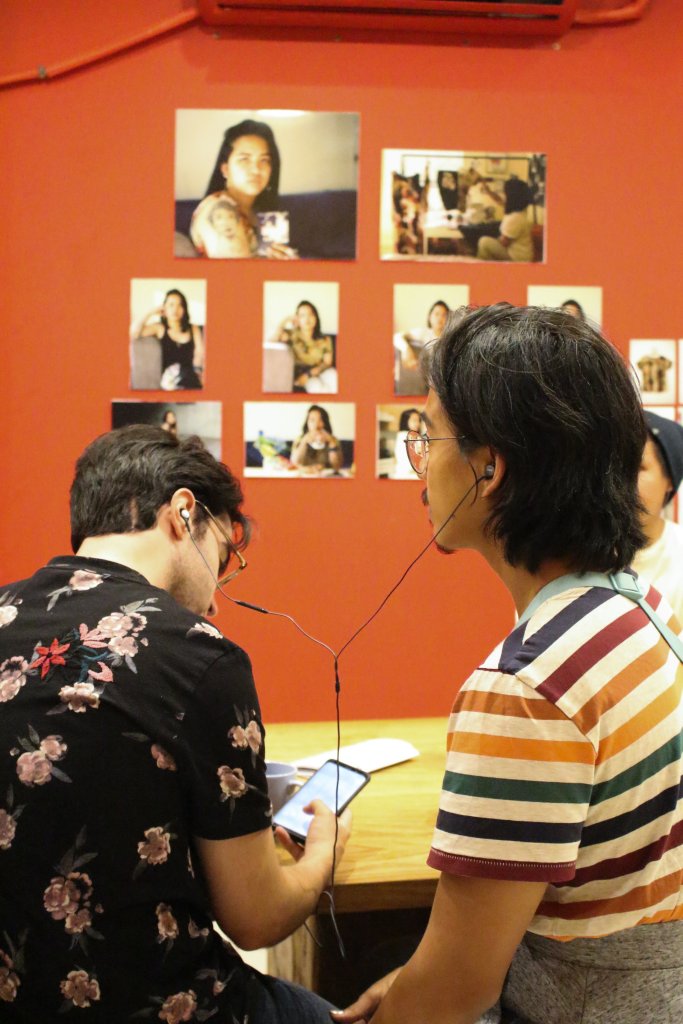
At the Wear We Came From exhibition, I was intrigued by how the community interacted with the visual and auditory experience, and how diverse the group of people who came was. Can you tell us about the process of collaboration, and the importance of such collaborative processes in creating spaces to hold intimate stories of culture and identity?
Witnessing a diverse array of age groups and cultural backgrounds coming together at the opening surprised me too. However, considering that the theme isn’t confined to a single demographic but resonates across a spectrum, the varied attendance made sense.
A collaborative process yields collaborative outcomes. For Wear We Came From, I provided support to Stephanie (photographer) and Izzy (multimedia journalist) in organizing and executing the project. In order to bring this project to life, we collaborated with ten individuals who graciously shared their stories and participated in photoshoots. The collective effort of our team allowed the project’s outcome to be genuinely collaborative—incorporating the ideas, stories, visions, questions, and musings of each participant. This approach also facilitates reaching a broader audience. In the case of challenging subjects like migration, familial histories, and cultural narratives, I strongly believe that engaging in collective discussions and lending attentive ears to each other are crucial for collective progress.
How have you changed since joining Project 40?
When I became part of Project 40, I was still a university student, studying cultural anthropology and art history. Prior to my engagement with Project 40, I was largely unaware of grassroots methodologies and organizational approaches. My involvement in the arts centered around mainstream institutions, particularly the places where I was employed at that time, and my aspirations also revolved around ambitious academic career goals.
As I actively engaged with Project 40 — taking on roles such as facilitating programming, collaborating with not-for-profit arts organizations, and connecting with a diverse range of individuals immersed in or intrigued by the arts — I encountered an entirely different facet of the arts sector. Here, art was being crafted around pivotal dialogues, by and for regular people, in a departure from its former perception as an exclusive cultural commodity. Through this journey, I also gained insight into the potency of shared vulnerability and storytelling, which foster connections among individuals within a specific space and time.
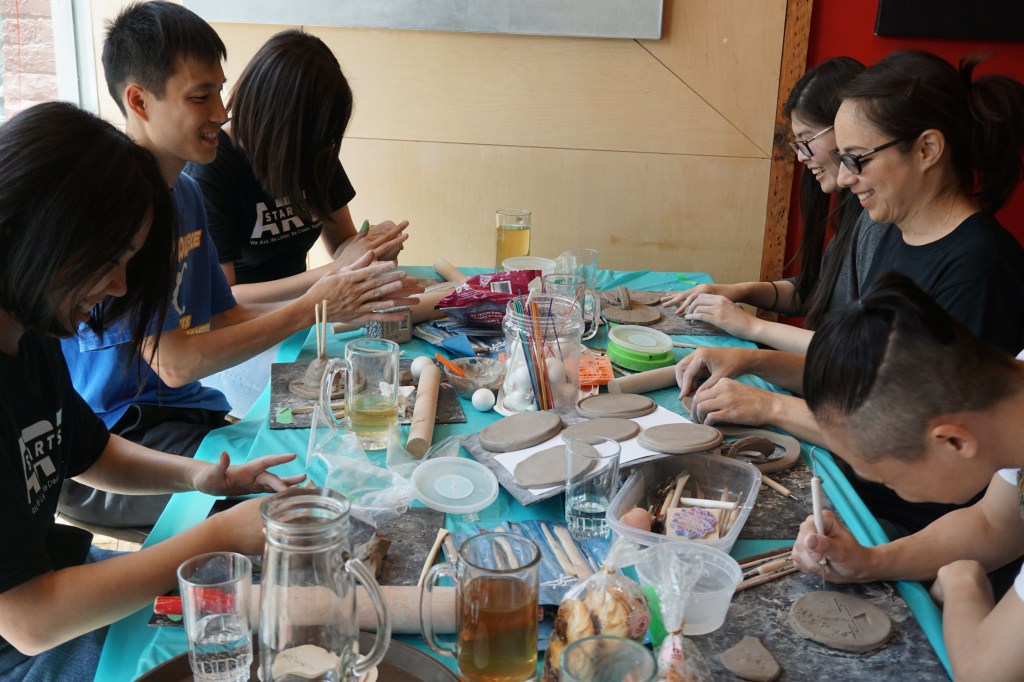
From co-facilitating the month-long workshop series titled burden(some) alongside Abby, I acquired the lesson of prioritizing our collective experiences, the shared environment, and the very process itself, over an undue fixation on the final outcome. This endeavor has unquestionably nurtured my personal growth, creativity, and experiential understanding, unfolding in ways I never anticipated or envisioned.
What are questions or themes you’ve been thinking about lately?
Lately, I’ve found myself deeply contemplating the term “정 情” (jung), which can be loosely interpreted as affection, compassion, and connection. I’ve been pondering the construction and perception of relationships, particularly within a societal framework that tends to emphasize individualism rather than collective well-being. I’ve been delving into the cultural variations of “정” and how it embodies swift attachment and fosters generosity, while we concurrently erect boundaries even with those we claim to cherish. These thoughts have extended to considerations about community care — do we genuinely prioritize it? Moreover, I’ve been reflecting on how language molds the dynamics of relationships, and how certain nuances can be expressed more effectively in one language compared to another.
What’s coming up next for you in your creative career?
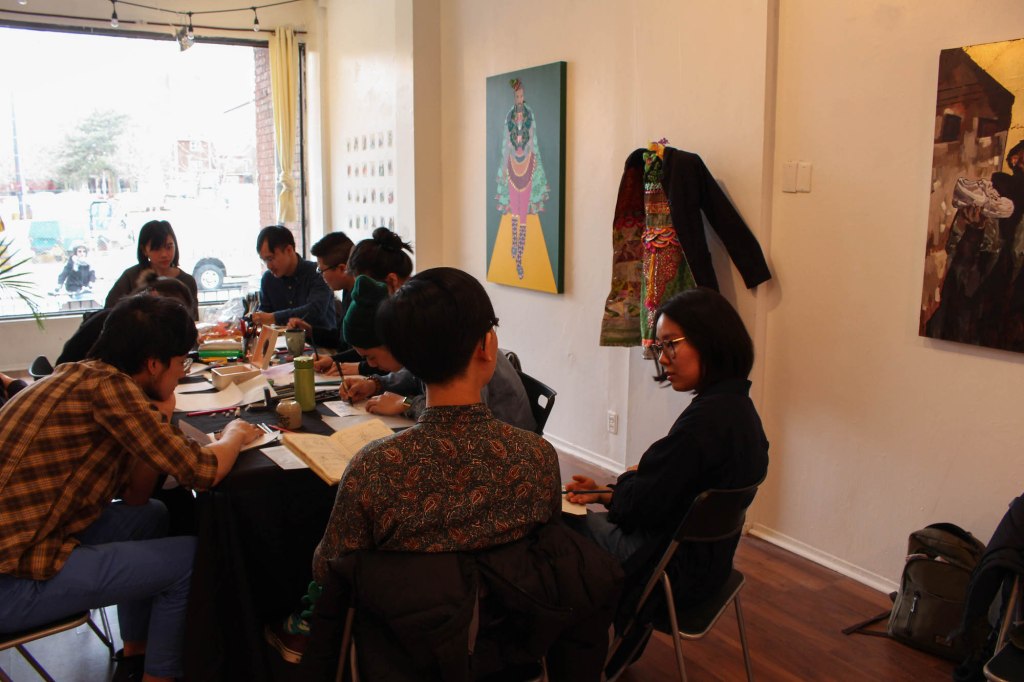
I will be relocating to Singapore in a matter of days to embark on a journey pursuing a Master’s in Arts and Cultural Leadership at LASALLE College of the Arts. This decision is not only motivated by academic pursuits, but also serves as a catalyst for venturing beyond my comfort zone and embracing challenges in an entirely new country. This endeavour holds the promise of deepening my involvement in the Asian arts scene, while also affording me the opportunity to reside in closer proximity to my family.
As for creative projects, most excitingly, I’m working on launching a digital magazine on diasporic Korean women with Harriet Kim with the first issue possibly featuring a firefighter and mokgyoktang — so stay tuned.
As the creator of these Creator to Creator series, how do you feel about the completion of the project? Did these conversations and connections formed fulfill the intentions that you had set out and answer the questions you wanted to address?
In total, I have showcased the work of 27 Asian. Canadian artists — among them, many whom I’ve never met face-to-face but admired through their exhibitions or on Instagram; others whom I’ve known but never had the opportunity to engage in profound discussions about their creative processes. Furthermore, I’ve also indirectly featured 27 Asian artists through the handwritten questionnaires.
I am immensely thankful for all those who dedicated their time to share their stories. I’m genuinely enthusiastic about the remarkable cohort of Asian. Canadian artists who are engaged in a diverse spectrum of creative expressions and delving into a wide array of subjects. Simultaneously, they are collaborating across disciplines and blending genres. My aspirations for this project align precisely with this endeavour: to spotlight the breadth of diversity within the Asian. Canadian diaspora and dismantle artistic boundaries. My desire is for Creator to Creator to make a meaningful contribution to this vibrant and burgeoning community.
Lastly, what does being part of the Canadian arts scene mean to you?
Acknowledging: Who am I? Who are the people? Who make up this community? What defines this community? Who holds privilege? What forms of privilege exist? What privilege do I possess? Where do I position myself? Whose land do I inhabit? What histories are embedded in it? What histories do I carry? Where do I originate from? What’s my purpose here? How do I navigate this world?
I believe that the exploration of identity, belonging, and place-making holds a distinct Canadian, and particularly Toronto, perspective for scrutiny. As I interact with individuals or listen to stories from beyond this city, it becomes evident that the discussions we’re engaged in are not occurring universally. It serves as a reminder that we need to acknowledge that substantial transformations can’t materialize when we confine ourselves to a limited perspective.
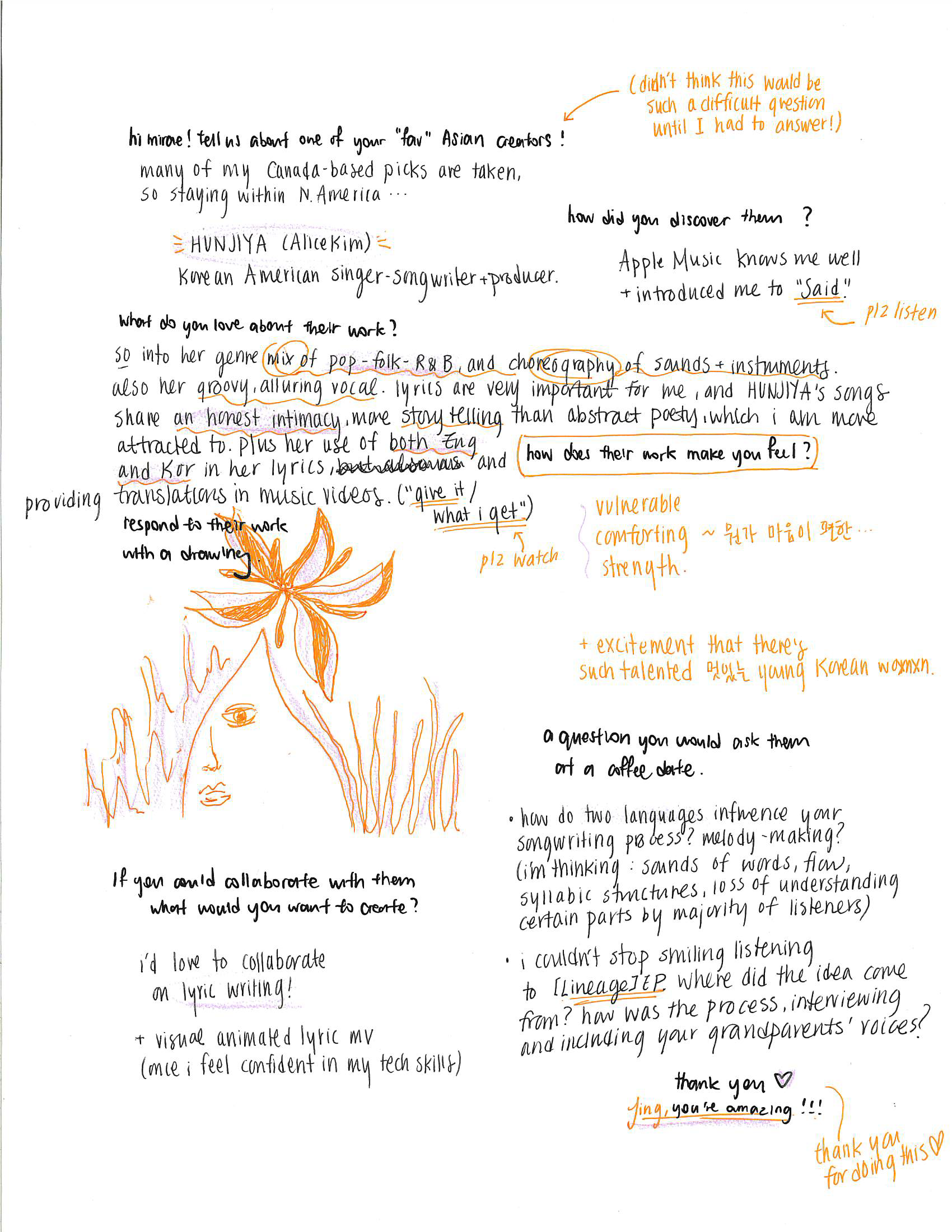
To listen to Hunjiya’s music, visit her website.
 Lee Mirae